
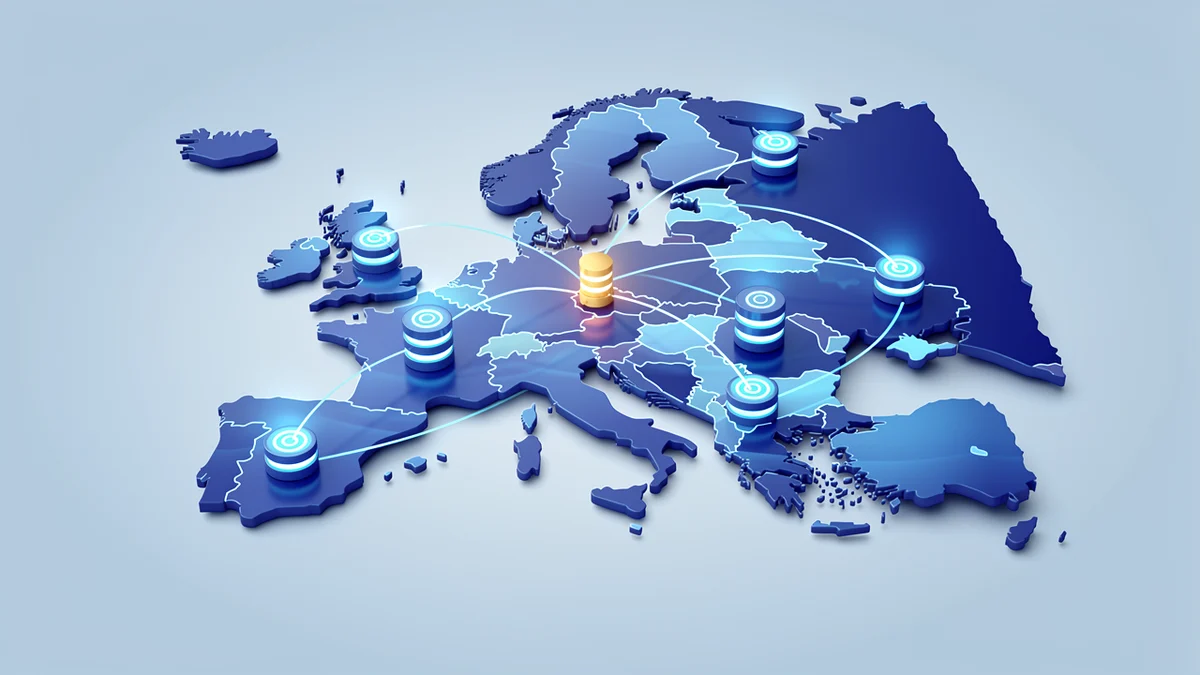
A European VPS is the standard step for a Ukrainian project that has outgrown shared hosting. But the moment you get specific, confusion starts: Netherlands or Germany, why one provider asks $4 and another $15 for similar specs, and whether Warsaw is really faster than Frankfurt. Let's go through it in order.
Latency differences between the main European sites are 10–20 ms for Ukraine, and for an ordinary website that's invisible. So choose on virtualisation type, disks and provider reputation rather than the flag on the map. Germany is usually cheaper than the Netherlands, too.
Real latency from Ukraine
Numbers worth keeping in mind when picking a location. These are averages from Kyiv — your provider's figures may differ by a few milliseconds.
- Warsaw, Kraków: 15–25 ms — the closest EU point to us
- Frankfurt: 25–35 ms — Europe's largest internet hub (DE-CIX)
- Amsterdam: 30–40 ms — the second most significant exchange point
- Paris, London: 40–50 ms
- US (for comparison): 120–160 ms
| Location | Latency from Kyiv | VPS 2/4 GB price | Note |
|---|---|---|---|
| Warsaw, Kraków | 15–25 ms | $8–12 | Physically closest |
| Frankfurt (DE) | 25–35 ms | $8–12 | DE-CIX, widest bandwidth |
| Amsterdam (NL) | 30–40 ms | $10–14 | AMS-IX, more liberal policy |
| US | 120–160 ms | $8–15 | Only for a US audience |
The practical conclusion: between European sites the difference is small enough that users won't feel it. The gap to the US is another matter — that latency is visible to the naked eye. So if your audience is in Ukraine or the EU, settle on any European location and then look at the technical parameters.
Germany, Netherlands or Poland
Germany offers the widest choice of providers and usually the best price per gigabyte of RAM. Frankfurt sits on DE-CIX, the world's largest traffic exchange, so bandwidth there is plentiful and cheap. The downside: German providers are stricter about content and act quickly on complaints.
The Netherlands traditionally has a more liberal content policy and equally strong connectivity through AMS-IX. Prices run slightly above German ones. Poland is physically closest and convenient for projects targeting the Polish market, though the provider selection is noticeably smaller.
Choosing a location by latency within Europe means optimising something nobody notices. What matters far more is whether the provider sold one server to three customers at once.
Ihor Jazov, ranking editor
What to check beyond location
Virtualisation type. KVM gives real isolation: dedicated memory, its own kernel, the freedom to install any OS. OpenVZ and LXC are containers where resources are shared and memory can be oversold to neighbours. At the same price, always take KVM.
Disks. "SSD" with no further detail is a reason to ask again in 2026. You want plain NVMe, not an "SSD cache" layered over ordinary drives. For a database-driven project this is the most noticeable speed difference.
Port and traffic. The baseline standard is 1 Gbps. "Unlimited traffic" nearly always means fair use: past a certain volume, speed is throttled. If you plan to serve media, look for concrete numbers in the terms.
What a European VPS costs
2026 benchmarks for KVM with NVMe: 1 vCPU and 2 GB RAM — $4–6 a month, 2 vCPU and 4 GB — $8–12, 4 vCPU and 8 GB — $15–25. German providers typically run 20–30% cheaper than Dutch ones at identical specs.
Cheaper offers ($2–3) usually mean one of three things: OpenVZ instead of KVM, heavy overselling, or a first-term-only price. That last one is the most common pattern: $3 for the first year, $9 after. Check the renewal cost before paying.
Paying from Ukraine
This is its own headache. Some European providers don't accept Ukrainian cards; others demand document verification on the first payment. Workable options: providers supporting PayPal, crypto, or those with a Ukrainian legal entity and hryvnia billing.
Before committing to an annual plan, take a month and confirm that payments go through and support answers sensibly. A 30% annual discount looks attractive right up until the first problem with a provider whose support stays silent for two days.
GDPR and jurisdiction
If any of your clients are EU residents, keeping their personal data on a European server simplifies things: the provider already operates under GDPR and the data never leaves the jurisdiction. For a purely Ukrainian business it isn't critical, but with European partners the question of where data physically sits comes up regularly.
What to pick for your case
A site or store with a Ukrainian audience — Poland or Germany, KVM from 2 GB RAM. A project serving the whole EU — Frankfurt or Amsterdam for the best connectivity. Media and file delivery — look at port speed and real traffic limits rather than the word "unlimited".
We've collected European providers with real specs, prices and user reviews in a dedicated ranking — you can see who offers KVM, who has NVMe and which locations are available.